
external view hotel with ev charging

Accommodation EV Charging

EV Chargers for Hotels and Motels in New Zealand

Attract EV-driving guests and offer convenient overnight charging with a solution designed for accommodation providers. Choose free guest charging, reception-managed charging or automated pay-as-you-go charging with QR-code payments — with equipment supplied from New Zealand stock and managed through our New Zealand-operated Kiwi EV platform.

Get a hotel charging quote Talk to us about your site

01 — Why offer guest charging

Make EV Charging an Amenity Your Guests Will Value

EV drivers actively plan trips around where they can charge overnight. A hotel or motel with on-site charging removes the need to find a public charger nearby — and that convenience is often the reason a guest books your property over a nearby property.

02 — Payment options

Choose How Guests Pay for Charging

The same charger hardware can support any of these arrangements — and you can change your approach later. The main difference is how the electricity cost is recovered.

Free guest charging

The hotel absorbs the electricity cost as part of the stay. The simplest option — no payment software required, and a strong point of difference for your listings.

Best for: Motels and boutique hotels using charging as a marketing amenity.

Reception-managed charging

Add a fixed charging fee to the guest’s accommodation account at check-in or check-out. No charging-platform subscription or transaction fees are required when you manage access and payment yourself.

Best for: Smaller properties with staffed reception and one or two chargers.

Automated pay-as-you-go

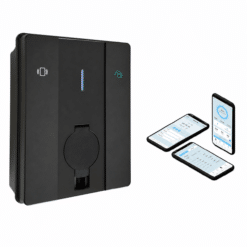
The guest scans a QR code on the charger, sees your price per kWh and pays electronically for the energy used. Charging revenue is paid to your account monthly through our Kiwi EV platform.

Best for: Hotels wanting hands-off cost recovery, or chargers also open to the public.

03 — Pay-as-you-go

How Pay-As-You-Go Hotel Charging Works

  1. Guest parks and scans the QR code on the charger with their phone.
  2. Your charging price is displayed on a secure web payment page — no app download needed.
  3. The guest enters their payment details and starts charging. The payment page authorises the session, and the guest can monitor charging progress from their phone.
  4. You monitor everything from one dashboard — sessions, energy use and revenue across every charger, with revenue paid to your account monthly.

You set the price per kWh and can adjust it at any time. A low monthly platform fee and card-processing costs apply, and these can be built into the rate guests pay. Kiwi EV is our New Zealand-operated OCPP charger management platform, so support is local.

Learn about the Kiwi EV platform
Kiwi EV ocpp platform

Internet connectivity for managed charging

Pay-as-you-go charging and remote management require a reliable internet connection at the charger. Depending on the charger and site, this may be provided through Wi-Fi, Ethernet or mobile connectivity. We can help identify the most practical option during planning.

04 — Load management

Avoid Overloading Your Hotel’s Electricity Supply

A hotel already places big demands on its electrical supply — kitchens, laundry, heating and hot water. Our chargers support dynamic site load management: a CT sensor at your main switchboard monitors the building’s total demand, and charging automatically reduces when the rest of the site is working hard, then ramps back up as capacity becomes available.

  • Charging works around your building’s existing loads
  • The installation is designed so the total charger load stays within your site’s capacity
  • Can help defer the cost of a supply upgrade at many sites
  • Cabling and capacity can be planned so more chargers can be added later

Because guests are typically parked for several hours, charging does not need to remain at full power continuously. A lower average charging rate can still add a substantial amount of range overnight.

Grid supply Main switchboard CT sensor monitors total demand Hotel loads Kitchen, laundry, heating EV chargers Charging rate adjusts automatically Charging power reduces as building demand rises, then increases again when capacity is available.

05 — Choosing hardware

Which EV Charger Is Best for a Hotel or Motel?

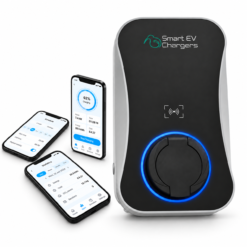
For overnight accommodation charging, a 7.4 kW wall charger is normally all you need. Over an eight-hour stay, it can supply up to approximately 59 kWh before charging losses, or around 50 kWh to the vehicle in typical conditions. A 22 kW three-phase charger is mainly worthwhile where the site has a suitable three-phase supply and guests’ vehicles can accept faster AC charging.

Solution Best for Key benefit
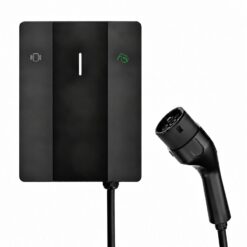
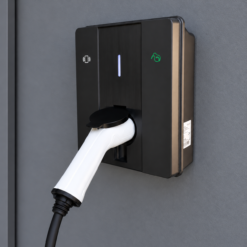
7.4 kW wall charger Small motels, or one or two dedicated EV parks Lowest hardware and installation cost; ideal overnight charging speed
Multiple 7.4 kW OCPP chargers Hotels expecting several EVs overnight Managed together on one platform, installed with dynamic site load management
Dual-output pedestal charger Two adjacent car parks, or open parking areas with no nearby wall Charges two vehicles from one freestanding unit
22 kW three-phase charger Sites with suitable three-phase supply Faster charging for compatible vehicles and shorter daytime stays

Not sure which configuration suits your property? Read our guide to choosing a hotel EV charger, or tell us your number of rooms, EV parks and supply type in the form below and we’ll recommend a setup.

$3,900.00 inc. GST
$979.00 inc. GST

Supplied from New Zealand stock with GST invoices, product documentation and commissioning support. Current pricing is shown on each product page. The electrical installation can be completed by a New Zealand registered electrician — we provide the charger documentation and commissioning support, or can help connect you with an installer familiar with our equipment.

06 — Proven at scale

Hotel EV Charging Already Operating Across New Zealand

We supplied and configured an EV charging network across multiple Scenic Hotel Group properties, working with electricians on the installation — giving guests convenient pay-as-you-go Type 2 charging while the hotel group monitors and manages every charger through the Kiwi EV platform.

“Smart EV Chargers were incredibly knowledgeable and helpful, providing us with a tailored solution that perfectly suited the needs of Scenic Hotel Group. With their expertise, we were able to implement an EV charging network across multiple hotels.

Smart EV Chargers took care of everything from installation to configuration, making it a hassle-free process for us.

Thanks to Smart EV Chargers, we now have a reliable EV charging infrastructure in place, contributing to our commitment to sustainability and enhancing the experience for our guests. We highly recommend Smart EV Chargers to any business looking to implement an EV charging solution.”

Chris Clayton — Scenic Hotel Group

07 — Costs and pricing

What Does a Hotel EV Charger Cost?

The total cost of a hotel charging project is made up of:

  • Charger hardware — see current pricing on each product page above
  • Electrical installation — cabling, protection and switchboard work
  • Trenching or pedestal work — where chargers are away from buildings
  • Payment software — a low monthly Kiwi EV fee for pay-as-you-go charging (none for self-managed charging)
  • Transaction processing — card-processing costs, which can be built into your per-kWh price
  • Optional extras — charging cables for reception, signage and wheel stops

There is no universal installation price — the biggest factors are the distance from the charger to your switchboard, whether trenching is required, and your site’s available electrical capacity. The closer the charger is to a switchboard, the cheaper the install. We can help arrange an electrician to quote, or you can use your own.

Example: what does a guest’s charge actually cost you?

A guest adding 40 kWh to their vehicle overnight uses 40 kWh of electricity. At an electricity cost of 25 cents per kWh, the hotel’s electricity cost is approximately $10, before network charges or other costs.

With pay-as-you-go charging, you set your own selling price per kWh and can adjust it at any time. Most hotels add a margin above their electricity cost to help recover:

  • Electricity and network charges
  • Payment-processing costs
  • Software costs
  • Installation costs
  • Ongoing maintenance

How much energy a guest actually takes varies widely — a plug-in hybrid may take under 15 kWh while a large EV arriving nearly empty could take 80 kWh or more — which is why per-kWh pricing is fairer than a flat fee for both you and the guest.

08 — Socket or tethered cable?

Type 2 Sockets or Attached Cables?

Most New Zealand-new EVs use a Type 2 vehicle connection, while many older Japanese-import EVs use Type 1. This is the main reason socket chargers are popular for accommodation.

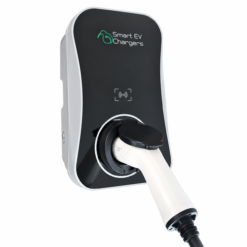
Type 2 socket charger

  • Drivers use their own cable — supports both Type 1 and Type 2 vehicles with the appropriate cable
  • Neater when not in use, with less cable wear and lower vandalism risk
  • Hotels can keep a Type 2 to Type 2 and a Type 2 to Type 1 cable at reception for guests who don’t carry one
  • Many travelling EV drivers carry their own Type 2 cable, making socket chargers a practical option for accommodation properties — cable availability can be noted on your PlugShare listing

Attached Type 2 cable

  • Easiest for guests — plug straight in, nothing to collect from reception
  • Mainly suited to Type 2 vehicles
  • Requires cable management on the charger or wall
  • A good fit where most guests drive New Zealand-new EVs and you want the simplest possible experience

09 — Start small

Plan for One Charger Now and More Later

Most properties start with one or two chargers. If the initial installation is planned well — cable routes, communications and load management sized with expansion in mind — adding chargers later is far simpler and cheaper. With compatible OCPP chargers, additional chargers can be managed through the same central dashboard.

Tell us your longer-term plans in your enquiry and we’ll make sure the first installation doesn’t box you in.

10 — Why us

Why Choose Smart EV Chargers NZ?

  • New Zealand stock, local support and local warranty backing
  • Kiwi EV — our New Zealand-operated OCPP payment and management platform
  • Free, reception-managed and pay-as-you-go charging options
  • OCPP-compatible equipment that isn’t locked to one software provider
  • Dynamic site load management to work within your building’s capacity
  • Wall-mounted and pedestal options for a wide range of parking layouts
  • Experience with New Zealand accommodation sites, including Scenic Hotel Group
  • Nationwide electrician coordination, or work with your own electrician

11 — Common questions

Frequently Asked Questions

Yes. Over an eight-hour stay, a 7.4 kW charger can supply up to approximately 59 kWh before charging losses, or around 50 kWh to the vehicle in typical conditions — enough to cover the typical energy required by most guests during an overnight stay. Faster 22 kW charging only helps where your site has three-phase supply and the guest’s vehicle can accept it.

Yes. With pay-as-you-go charging through the Kiwi EV platform, you set your own price per kWh and can adjust it at any time. Guests pay for exactly the energy they use, and revenue is paid to your account monthly.

Yes. Guests scan the QR code on the charger and pay through a secure web payment page with a credit or debit card. No app download is needed to start and pay for a charging session.

Not necessarily. Many travelling EV drivers carry their own cable. With a socket charger, you can optionally keep Type 1 and Type 2 cables at reception for guests who need one, and note cable availability on your PlugShare listing.

Yes. A Type 2 socket charger works with Japanese-import EVs that have a Type 1 vehicle inlet when a Type 2 to Type 1 cable is used. This is a key advantage of socket chargers for accommodation providers.

Yes. Chargers can be limited to authorised users through the management platform, operated through reception, or set as pay-as-you-go so any use is paid for at your rate. You choose whether chargers are private to guests or listed publicly as destination chargers.

Often, yes. Dynamic site load management monitors your building’s total demand through a CT sensor and automatically reduces charging when the rest of the site is under load. The installation is designed so the total charger load stays within your site’s capacity, which can help defer a supply upgrade at many sites.

Yes. If cable routes, communications and load management are planned with expansion in mind, additional chargers can be added later and connected to the same management dashboard.

Yes. The electrical installation can be completed by a New Zealand registered electrician. We provide the charger documentation and commissioning support, or can help connect you with an installer familiar with our equipment.

Installation cost depends on the distance from the charger to your switchboard, whether trenching or a pedestal is required, and your site’s available electrical capacity. The closer the charger is to a switchboard, the cheaper the install. We recommend getting a site-specific quote rather than relying on a universal figure.

More Commercial Charging Solutions

Commercial EV charging  •  Workplace EV chargers  •  Fleet EV charging  •  Kiwi EV OCPP management software  •  Guide: choosing a hotel EV charger

Get started

Planning EV Charging for Your Accommodation Property?

Tell us your property name and location, how many rooms and car parks you have, how many chargers you’re considering, and whether you want free or paid charging. We’ll recommend a practical setup covering charger selection, payment options, load management and installation.

Phone 022 456 4874 or email sales@smartevchargers.co.nz