Bidirectional EV Charging
What is Vehicle-to-X? V2L, V2H & V2G Explained
A New Zealand guide to bidirectional charging — how your EV battery can power your tools, your home, and even the grid.
Bidirectional EV Charging
A New Zealand guide to bidirectional charging — how your EV battery can power your tools, your home, and even the grid.
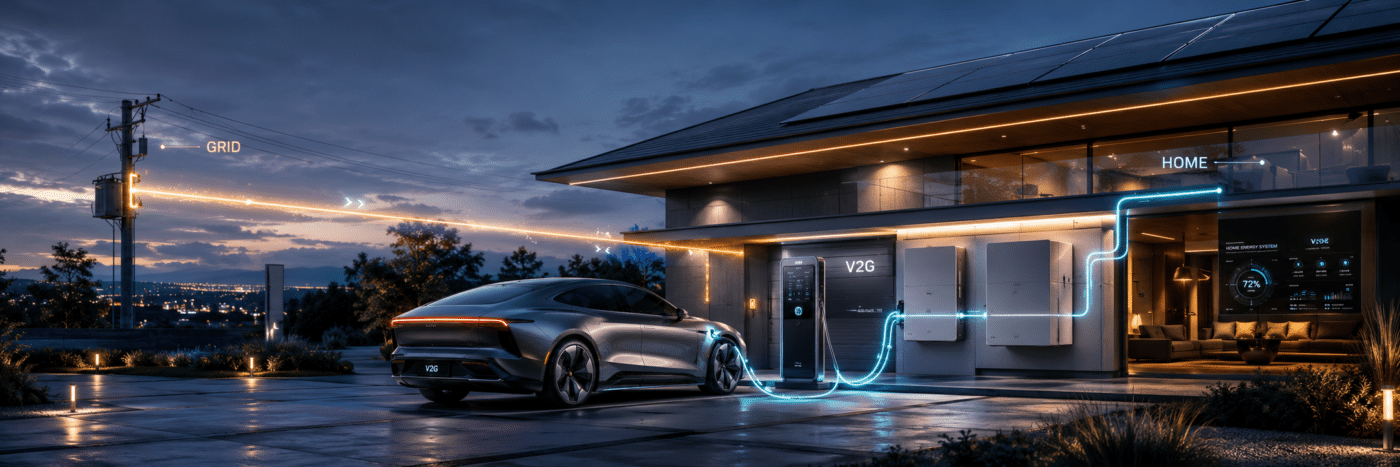
Vehicle-to-Grid (V2G), Vehicle-to-Home (V2H), and Vehicle-to-Load (V2L) let electricity flow both ways between your EV battery and your home, grid, or devices.
Rather than just taking power from the wall, a bidirectional setup lets your car give power back — on your terms.
For New Zealand EV owners, this is no longer a future technology. The Energy Efficiency and Conservation Authority (EECA) is running a real-world V2G trial in Queenstown, the electrical standards have been updated to allow it, and simple V2L-based home backup is something you can set up today.
They all use the EV battery as an energy source — each one just sends power to a different place.
Simplest — available now
Plug a V2L adapter into your car’s charge port and get a standard 230 V outlet. Power tools on a job site, camping gear, or appliances during an outage. No charger needed — some EVs even have built-in outlets.
Home backup & savings
Power your home directly from your EV battery during peak hours or grid outages. With 40–100 kWh of storage on board, you can run essentials for hours or days — valuable during NZ weather events and in rural areas where supply can be unreliable.
The end goal
Push power from your car’s battery back into the grid — and get paid for it. Charge overnight on cheap rates or from solar, then export your stored energy during peak demand, earning credits the way a solar feed-in tariff does.
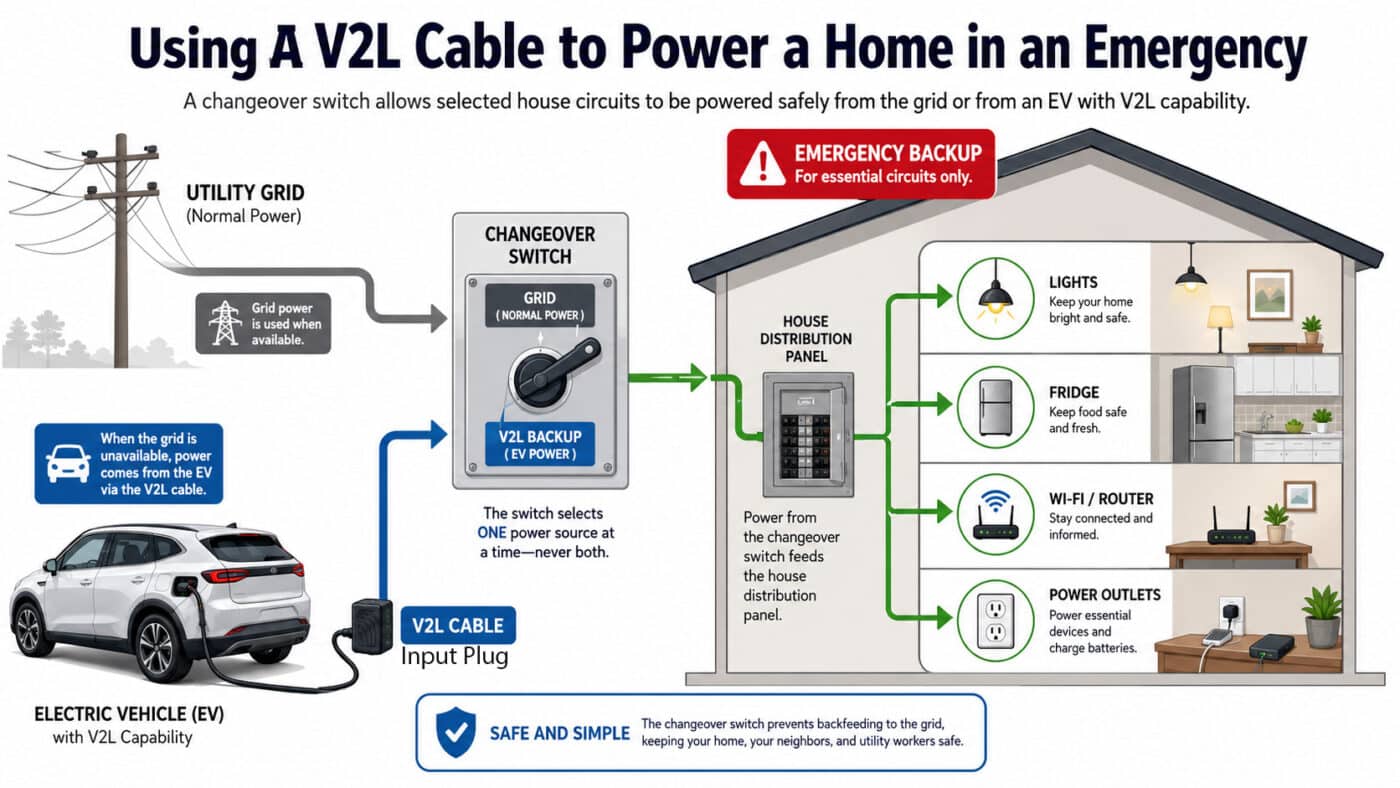
You don’t have to wait for a bidirectional charger to use your EV as backup power for the house. If your EV supports V2L, you can combine a V2L adapter with a generator inlet plug and changeover switch — the same setup Kiwis have used for petrol generators for decades.
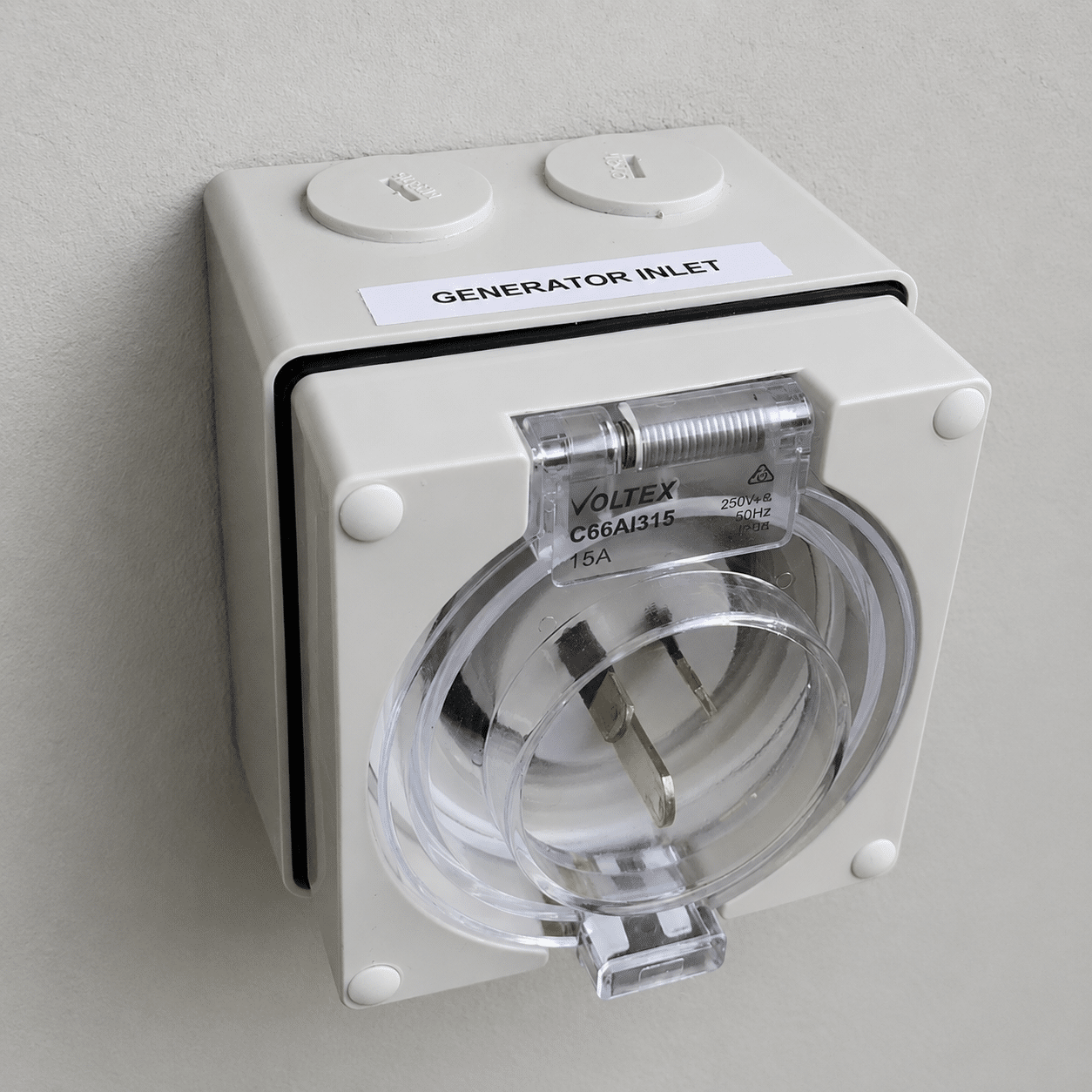
External V2L inlet plug installed ready to connect to a V2L cable.
Good to know: Most V2L-capable EVs supply around 2.4–3.6 kW — enough for lights, refrigeration, comms, and modest appliances, but not the whole house at once. A 60 kWh battery can keep essentials running for well over a day.
Safety first: The inlet and changeover switch must be installed by a registered electrician. The changeover switch fully isolates your home from the grid before the EV feeds it — this prevents dangerous back-feed into the network and keeps line workers safe. Never connect a V2L outlet to house wiring any other way.
Full V2H (where the charger feeds your switchboard automatically) comes in two flavours. The difference is simple: where does the inverter live?
The wallbox is a bidirectional DC charger. Your EV supplies raw DC straight from its battery pack, and the charger converts it to 230 V AC for your home.
The vehicle’s onboard charger works in reverse, converting battery DC to 230 V AC inside the car and exporting it through the Type 2 port. The wallbox is a (relatively) simple smart AC unit that manages the export.
In short: DC V2H puts the cost and complexity in the charger and works with more vehicles; AC V2H keeps the wallbox simple but demands more from the car. Most bidirectional hardware arriving in Australia and New Zealand today is DC-based, because it doesn’t have to wait for carmakers to fit bidirectional onboard chargers. Either way, both must comply with AS/NZS 4777 to connect to your switchboard.
A V2G charger needs to communicate properly with the vehicle and connect safely to the electrical system.
ISO 15118 is the international protocol that lets your EV and charger “talk” securely. It handles authentication, charging rates, and crucially — bidirectional power flow instructions.
ISO 15118-2 covers one-way charging. ISO 15118-20 is the new standard explicitly designed for V2G — it adds the messaging needed for your car to safely discharge power back through the charger.
This joint Australian–New Zealand standard governs how inverter-based systems such as solar, batteries, and EV chargers safely connect to the grid.
AS/NZS 4777.1:2024 now explicitly includes bidirectional EV chargers. It requires grid-quality power, automatic disconnection during outages, and installer compliance.
ISO 15118 is the international communication standard that governs the digital “conversation” between an EV and a charger.
Think of it as the language the car and charger speak to each other — confirming who the vehicle is, how much energy is available, how fast it can charge or discharge, and whether the session is authorised — all without you touching an app or tapping a card.
Without a standard like ISO 15118-20, every car and every charger brand would need its own custom handshake — the kind of fragmentation that has slowed bidirectional charging globally.
This is why we’ve chosen it as the foundation for our own charger under development: building to an open, internationally recognised standard means it is positioned to work with the growing range of EVs that support bidirectional charging, rather than a closed list of one or two compatible models.
AS/NZS 4777 is the joint Australian/New Zealand standard for connecting inverter-based energy systems — like solar inverters, home batteries, and now bidirectional EV chargers — to the electricity grid.
AS/NZS 4777.1:2024 now explicitly recognises Mode 3 (AC) and Mode 4 (DC) EV chargers as eligible for reverse power flow. In other words, it formally opens the door for V2G and V2H through compliant EV chargers, where previously the standard was not written with bidirectional EV charging in mind.
Standard portable Mode 1 and Mode 2 chargers — your typical plug-in EVSE — remain outside this scope and are not able to export power.
In short: ISO 15118 handles the conversation between car and charger, while AS/NZS 4777 governs how the charger is allowed to behave once it is talking to the grid. A genuinely V2G-ready charger for the NZ market needs to get both right.
Note: the V2L + changeover switch setup described earlier sits outside AS/NZS 4777, because the changeover switch fully disconnects the house from the grid — no power is ever exported to the network. That’s what makes it achievable today.
New Zealand is earlier in this journey than some overseas markets, but momentum is building quickly.
The Energy Efficiency and Conservation Authority is running New Zealand’s first comprehensive V2G trial, in partnership with Rewiring Aotearoa and the Queenstown Electrification Accelerator.
An initial tranche of chargers is being installed in 2026, with plans to expand to 30–40 chargers across homes and businesses and a year of data collection to follow.
A separate V2X urban trial is also being scoped, looking at vehicle-to-home and vehicle-to-everything use cases in city settings, not just regional ones. More on the EECA site
With AS/NZS 4777.1:2024 now recognising bidirectional EV chargers, the regulatory groundwork that previously held the technology back is falling into place.
Bidirectional chargers built to ISO 15118-20 are beginning to reach the Australian and New Zealand market, generally starting with DC-based V2H home backup before full grid-export V2G functionality becomes widely available through retailers.
What is still being worked out: how retailers, lines companies, and the Electricity Authority will handle the commercial side — how you would get paid for exporting, how that interacts with your existing electricity plan, and which networks are ready to accept two-way flow from EVs at scale.
There’s nothing preventing it in principle, and the relevant standard (AS/NZS 4777.1:2024) now explicitly allows for bidirectional EV chargers. In practice, any installation still needs to meet your local network operator’s connection requirements and be carried out by a registered electrician — and the commercial side, such as how exporting affects your power bill, is still being worked through via trials like EECA’s Queenstown project.
Yes — if your EV supports V2L. A V2L adapter combined with a generator inlet plug and manual changeover switch (installed by a registered electrician) lets your EV run your essential circuits during an outage, exactly like a portable generator would. See the “V2H you can do today” section above for how it works.
It comes down to where the power conversion happens. With DC V2H, the wallbox contains the inverter and the car supplies raw DC — so the charger is more expensive but works with more vehicles. With AC V2H, the car’s onboard charger converts the power itself and exports AC — the wallbox is simpler and cheaper, but very few EVs sold in NZ currently have a bidirectional onboard charger. Most bidirectional hardware arriving here today is DC-based.
Extra cycling can contribute to battery wear over time, but a well-designed system manages charge and discharge rates to limit the impact. Battery degradation depends on several factors — build quality, usage patterns, and discharge rates among them — and manufacturers building V2G-capable vehicles are designing their battery management systems with this in mind.
Yes — your EV needs to support bidirectional charging at the hardware level, and ideally support the ISO 15118-20 standard for the smoothest compatibility with newer chargers. Not all EVs currently sold in New Zealand support this, so it is worth checking with the manufacturer before assuming your car is V2G-ready.
They do a similar job — storing energy and releasing it later — but a home battery is a fixed, dedicated unit, while your EV is already a large battery you own anyway, sitting unused for most of the day. V2G lets you get extra value from a vehicle you have already paid for, without buying a separate battery system from scratch.
Browse our V2L adapters, or get in touch to talk through your home or business setup.