
Solar EV chargers
Solar EV charging guide for New Zealand. We can supply different EV chargers that are capable of diverting excess energy from your solar setup in to your car battery.
Charging at home with Solar
Charging using solar is as simple as charging your car while you are generating power using your solar.
This can be done manually with your standard 8a granny charger or faster with a 16a charger with a caravan plug. However if you want to get the most out of your solar you are best to use one of our solar capable wall chargers that can vary its output to either pick up any excess power going to the grid. Or to match the rate the car is charging with the output of the inverter. See the bottom of the page for the wall chargers.
How does Solar EV charging work?
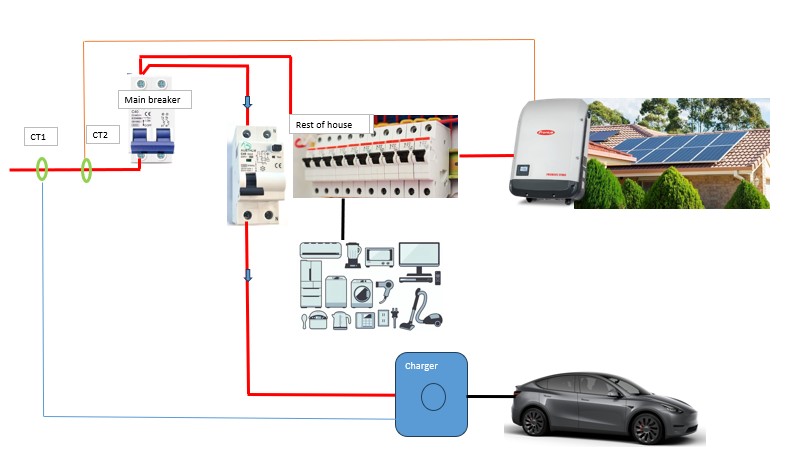
A typical Solar EV charging setup is shown above. The CT clamp is installed on the main cable coming in to the house. The charger can then see what direction the current is flowing and determine how much current is flowing in each direction.
Based on this the charger will vary the current going to the car to ensure no excess electricity is going out to the grid and its all being consumed.
Our Smart EV charger branded charger monitors any import and export. If you are exporting 8a or more charging will begin and take up this excess. If the home load increases then the charger will automatically reduce the current to the car to avoid importing and power.
If there is no longer any excess power the charging will pause. It will begin again when it detect excess.
What is the minimum rate an EV can charge from Solar?
The minimum charge a car can take before it will switch off is 6 to 8 amps depending on the car or 1.3kW. If the charge falls below this the EV charger will pause charging.
How long will it take to charge my car using solar?
Calculating the charge time using Solar.
Charging using solar is no different from charging using your standard power. The rate of charge depends on the following variables.
-
The size of your solar setup
-
The size of your car battery and its current state of charge
-
How much power your solar energy your house uses.
You can use our EV charging calculator to work out the charge time. Input the charge current.
This should be how much solar your system is capable of producing or the excess solar that you export.
Example:
7kW system can produce 32a
4.4kW system can produce 18a
3.5kW system can produce 16a
The average size solar setup in New Zealand is 4.4kW base on information from the Electricity Authority
Solar EV charge time Calculator |
|||||||||
|---|---|---|---|---|---|---|---|---|---|
|
|||||||||
|
|||||||||
EV charging Speed and efficiency
It is more efficient to charge your car faster at 7kW or 32a than it is to trickle charge at 10a or 2.4kW .
Testing has shown that charging a BYD using a granny charger is around 87% efficient. Where as when charging between 16a and 32a the efficiency is around 91%.
This is because there are losses in the system. If you are charging for longer the battery management system and cooling system is running for longer. These use power. As does the A.C to D.C converter in the car.
This is why we recommend using a dedicated wall charger that has solar diversion capabilities over the standard plugin charger.
Using an EV charger with a home battery and Solar
Trying to balance what to charge with an EV and home battery can be tricky if not setup correctly.
Ideally you will want to charge whatever battery you are going to need the most first. So, if you are not using the car, then charger the home battery and use the car to take up any excess. This is only good for people that have a car at home and are not doing many km.
If you do need more power in the EV, then its best to charge the EV battery first rather than discharging the home battery in to the EV. There are losses in the system so its most efficient to direct the energy to where you need it. For example, a Tesla Power wall 2 is 92% efficient. The Power wall 3 is more efficient at 96%.
How to stop your home battery discharging in to an EV?
To do this the charger must be invisible to the battery/Solar setup. When the charger is installed the CT clamp for the Solar battery setup must measure the total load of the house excluding the EV. The Circuit for the EV charger should be separate as you can see by CT2 in the diagram.
CT1 from the charger is then installed so it can measure the total load as well as detect any power that’s being exported.
With this setup, if your home battery is fully charged and you are generating excess solar then CT1 will pick up that you are exporting electricity and start to charge the car.
This will be invisible to the inverter/battery so it will not push power in to the system.
The only disadvantage to this is the App for the Solar will think you have exported this electricity. When really you have diverted it in to the car. Also if you need to charge the car say at night, the power usage won’t read on the inverters app. Your power company will still charge you for it.

Our Solar Capable Chargers
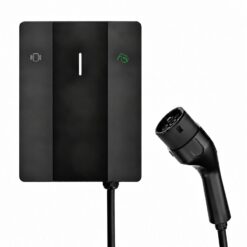
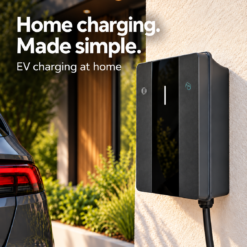
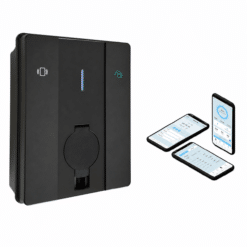
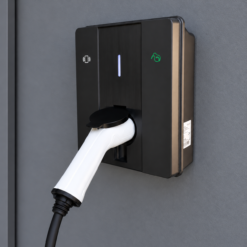
Smart EV Chargers
Starting with our Smart EV charger brand of charger. These are avaiable in socket version or with a Type 2 cable attached.
These have 2 Modes.
ECO mode: When in ECO mode, the charger will automatically start and stop charging when it detects excess solar going to the grid. It will ramp the charging rate up and down to take up the excess solar and divert it to your car. The included CT clamp must be installed for this function.
Standard mode: This will ignore what your solar is doing and provide you with the fastest charge possible to get you moving.