NZ Wiring Rules Update · AS/NZS 3000:2018

New EV Charger Testing Requirements NZ 2026

New Zealand’s electrical rules are changing. The Electricity (Safety) Amendment Regulations 2025 move the cited Wiring Rules from AS/NZS 3000:2007 to AS/NZS 3000:2018 including Amendments 1, 2 and 3 — and for EV charger installers, the biggest practical change is in Section 8 verification and testing: RCD function testing, trip times and DC leakage.

View the EVSE Charger Test Tool Talk to us about test equipment
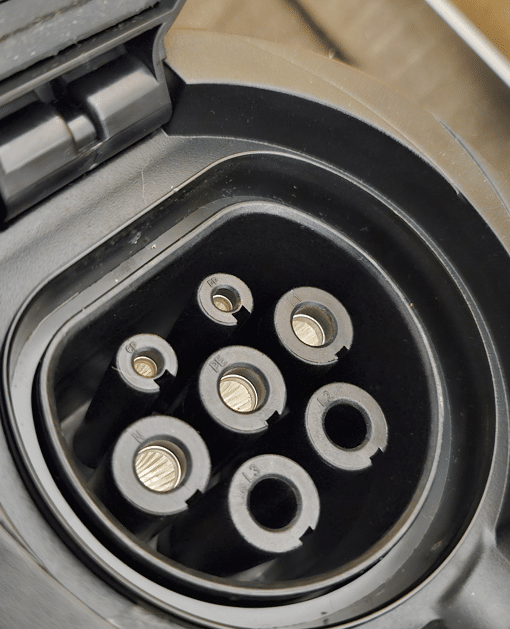
Type 2 socket

01 · Key dates

What is changing from November 2026?

Electrical workers can currently use either the previously cited AS/NZS 3000:2007 or the newly cited AS/NZS 3000:2018, subject to the transitional provisions. That flexibility ends for new work beginning after 12 November 2026.

13 Nov 2025

Amended regulations in effect

The Electricity (Safety) Amendment Regulations 2025 came into effect, updating the standards cited under the Electricity (Safety) Regulations.

Transition period

Either standard may apply

During the transition, work can comply with AS/NZS 3000:2007 or AS/NZS 3000:2018, subject to the transitional provisions for each type of work.

13 Nov 2026

AS/NZS 3000:2018 + A1, A2, A3

Work beginning after 12 November 2026 must generally comply with AS/NZS 3000:2018 including Amendments 1, 2 and 3.

AS/NZS 3000:2018 also includes specific requirements for electric vehicle supply equipment under Section 7.9 – Supplies for electric vehicles. But one of the most significant practical changes for electricians commissioning EV chargers is the New Zealand modification to Clause 8.3.10 – RCD testing.

02 · Clause 8.3.10

RCD testing is becoming more comprehensive

The New Zealand citation of AS/NZS 3000:2018 modifies Clause 8.3.10. Importantly, the wording that previously allowed RCD function testing to be carried out simply by operating the RCD’s integral test device has been removed.

The amended requirements specify that RCD function testing must include:

  • RCD trip time
  • Confirmation that the functions of the RCD operate as intended
  • Confirmation that operation of the RCD provides protection against electric shock
  • The presence of DC leakage (for residual sinusoidal AC and residual pulsating DC)
  • Constant DC, where applicable

For electricians installing EV chargers, the reference to DC leakage and constant DC is particularly important.

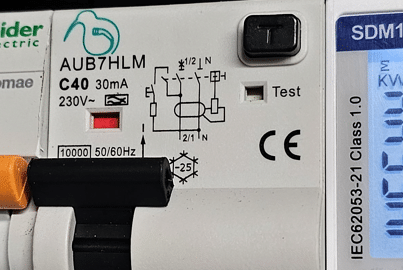
Why pressing the TEST button isn’t enough

The integral TEST button confirms that the RCD can operate using its internal test circuit, but it does not measure the RCD’s actual trip time. The New Zealand modification to Clause 8.3.10 removes the option of relying on the integral test device alone for function testing. A suitable RCD tester is required to verify trip time and the applicable protective functions.

The important change for electricians

Under the newly cited Wiring Rules, simply confirming that an RCD operates is not enough — the function test must include RCD trip time. A tester displaying only PASS/FAIL may still be suitable if that result is based on an actual trip-time measurement against the applicable limits. A device that simply confirms that the RCD tripped does not provide the same verification.

03 · DC leakage

Why DC leakage matters with EV chargers

This matters because DC residual current can saturate or “blind” some conventional RCDs. When that happens, the RCD may no longer respond correctly to a normal AC earth fault. In other words, the DC component can mask an AC fault, preventing the protection device from detecting and tripping as intended.

Sinusoidal AC

The conventional residual-current waveform that standard AC RCDs are designed to detect.

Pulsating DC

Residual currents with a pulsating DC component, detected by Type A RCDs but not Type AC devices.

Smooth / constant DC

Smooth DC residual current that can blind conventional RCDs — the key risk with EV charging circuits.

The New Zealand modifications also require (Clause 1.5.6.3) that any RCD forming part of an installation is selected and installed to be compatible with the types of load intended to be used within the installation, with consideration given to potential pulsating and constant DC fault currents and waveform distortion. Simply installing a standard RCD without considering the characteristics of the EVSE is not appropriate.

04 · Protection arrangements

Type B RCD or Type A + 6mA RDC-DD?

A common point of confusion with EV chargers is the difference between a Type B RCD and the 6mA DC protection incorporated into many modern EV chargers. WorkSafe’s current EV charging guidance recognises both appropriate Type B protection and, where correctly designed and compliant, a Type A RCD combined with an RDC-DD complying with IEC 62955.

Option 1

Type B RCD

A Type B RCD detects sinusoidal AC, pulsating DC and smooth DC residual currents. Where the EVSE does not provide compliant DC residual-current protection internally, a Type B RCD may be required on the charging circuit.

Option 2

Type A RCBO in the switch board + RDC-DD in the charger (IEC 62955)

An RDC-DD is a Residual Direct Current Detecting Device. IEC 62955 covers RDC-DDs for Mode 3 (AC) charging, and many modern AC wall chargers incorporate one to detect smooth DC residual current, commonly at a 6mA DC operating threshold.

Does every EV charger need a Type B RCD?

No. The correct protection arrangement depends on the EVSE

If the EV charger has a built in RCD-DD that meets IEC62955 then you only require a Type A at the switch board. All of our Smart EV chargers have this protection.

Electricians should always confirm the protection provided by the particular EVSE rather than assuming all chargers are the same.

05 · Verification

Do electricians now have to test the 6mA DC protection inside an EV charger?

The new Wiring Rules do not simply state that every EV charger must undergo a “6mA ramp test.” However, the New Zealand modification to Clause 8.3.10 requires appropriate RCD function testing and specifically brings DC leakage and constant DC where applicable into the verification requirements.

Where an EV charging installation relies on DC residual-current protection, electricians therefore need to consider how that protective function is verified. For EVSE incorporating an IEC 62955 RDC-DD, suitable EV charging test equipment can be used in conjunction with an appropriate multifunction installation tester to simulate a vehicle and allow the DC protective function to be tested.

This is becoming an increasingly important capability when commissioning EV chargers.

06 · WorkSafe guidance

WorkSafe already recommends purpose-built test equipment

WorkSafe’s EV Charging Safety Guidelines go further than the Wiring Rules alone. Following installation of an AC charging station, the guidance calls for RCDs to be tested using a purpose-built RCD tester and for charging-station safety functions, including earth-continuity monitoring, to be tested using purpose-built test equipment.

WorkSafe also recommends that the results of this testing are recorded with the relevant electrical certification.

This is where an EVSE vehicle simulator combined with an appropriate installation tester becomes particularly useful.

Following installation of an AC charging station, installers should undertake:

  • Verification of RCD type and rating
  • Earth-continuity checks
  • Testing of all RCDs using a purpose-built RCD tester
  • Testing of the charging station’s safety functions using purpose-built test equipment
  • Recording the test results with certification

07 · Test equipment

What equipment is needed to test an EV charger?

A common EVSE commissioning setup uses two pieces of test equipment.

evse test meter AC ev charger tester

1

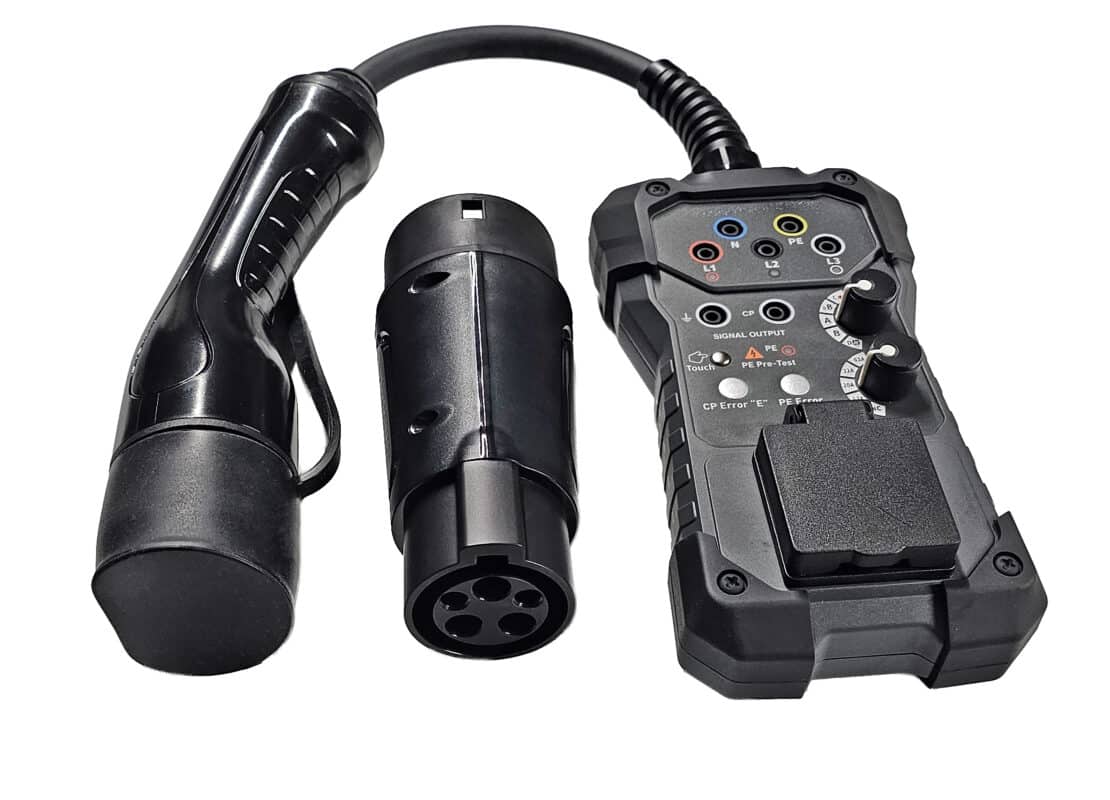
EVSE test adapter / vehicle simulator

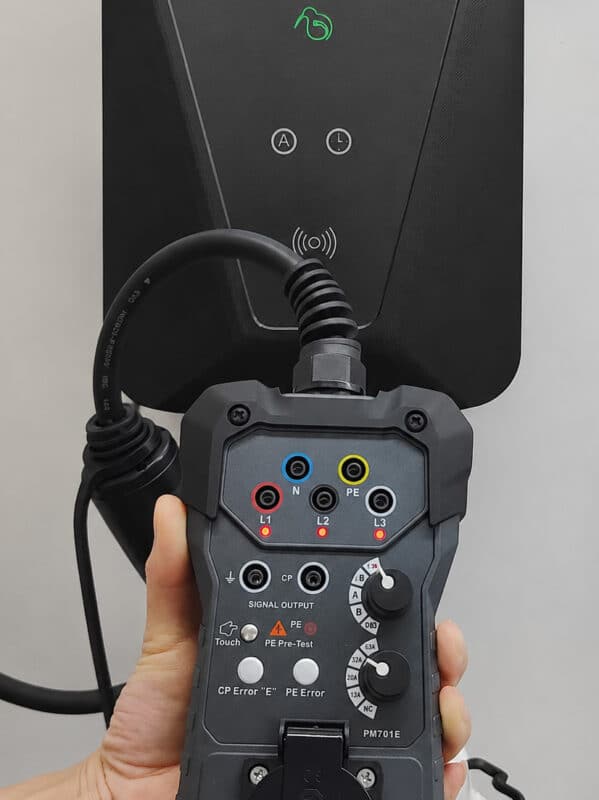
Simulates the connection of an electric vehicle, placing the charging station into different operating states without connecting an actual car. A suitable EVSE tester can provide:

  • Control Pilot (CP) State A, B and C simulation
  • Proximity Pilot / cable current simulation
  • Protective earth testing
  • CP and PE fault simulation
  • Access to L1, L2, L3, neutral and earth
  • Connection points for an installation tester
  • Confirmation the EVSE energises and disconnects correctly
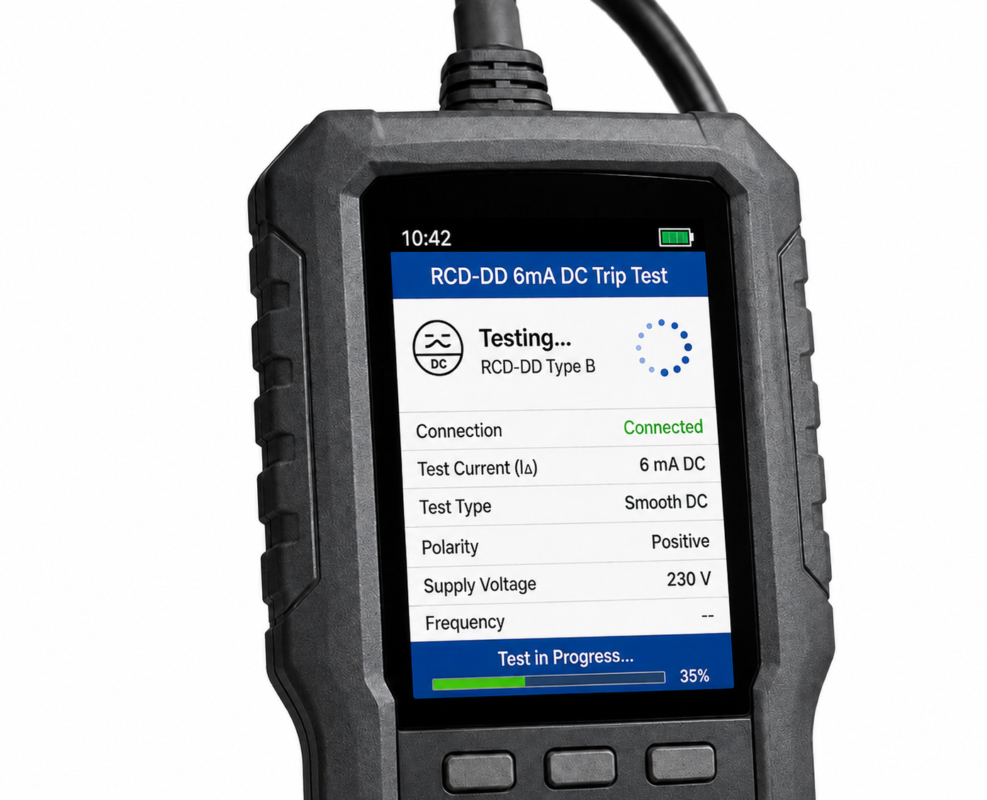
RCD-DD EVSE tester

2

Multifunction installation tester

Used together with the EVSE adapter for the electrical measurements. Depending on the equipment being tested, this can allow testing of:

  • RCD trip time and trip current
  • Type A RCD operation
  • Type B RCD operation
  • RDC-DD / 6mA smooth DC protection
  • Earth fault loop impedance
  • Insulation resistance
  • Protective conductor continuity

The distinction matters: the EVSE test adapter simulates the vehicle and provides access to the charging circuit. The compatible installation tester generates and measures the relevant RCD/DC test currents.

08 · Worked example

EVSE testing example

Consider a typical 7.4kW single-phase residential EV charger incorporating 6mA DC residual-current detection. A commissioning process may include:

  1. Verify the installation and protective conductor.
  2. Confirm the correct RCD/protection arrangement for the charger.
  3. Connect an EVSE simulator.
  4. Simulate EV connection – CP State B.
  5. Simulate a vehicle requesting charge – CP State C.
  6. Confirm the EVSE contactor closes and output becomes live.
  1. Verify the charging voltage.
  2. Test the relevant RCD protection using a compatible installation tester.
  3. Where applicable, verify operation of the EVSE’s DC residual-current protection.
  4. Simulate a protective-earth fault and confirm the charger shuts down.
  5. Simulate a Control Pilot fault and confirm the charger responds correctly.
  6. Record the relevant test results as part of the installation verification.

The exact tests required will depend on the EVSE, protection arrangement, installation and manufacturer’s instructions.

09 · For NZ electricians

EVSE Charger Test Tool

For electricians installing and servicing EV chargers, our EVSE Charger Test Tool provides a simple way to simulate an electric vehicle and access the charging circuit for commissioning and electrical testing.

  • Type 2 EVSE testing
  • Type 1 testing (adapter included)
  • CP State A/B/C simulation
  • Cable current simulation
  • PE Test
  • PE Error simulation
  • CP Error simulation
  • L1/L2/L3 output indication
  • Voltage test points
  • NZ load socket
  • Multifunction tester connection

When used with a compatible multifunction tester, the EVSE simulator can also provide the interface required for RCD and RDC-DD / 6mA DC testing.

View the EVSE Charger Test Tool →

10 · Instruments

Compatible installation testers

Not all multifunction testers can perform the same EV charging tests. In particular, conventional RCD testing capability does not necessarily mean an instrument can test 6mA smooth DC / RDC-DD protection.

Before purchasing a tester specifically for EV charger commissioning, confirm the instrument supports the RCD and 6mA DC residual-current tests.

Check before you buy

Check the manufacturer’s specifications for the specific tests you need — or contact us for help determining whether your existing multifunction tester can be used for EVSE and 6mA DC testing.

11 · Installation requirements

Is an isolator required beside an EV charger?

For residential Mode 3 and Mode 4 charging facilities, AS/NZS 3000:2018 requires an isolating switch complying with Clause 2.3.2.2.1, rated at not less than 32A, to be provided for the final subcircuit adjacent to the charging facility.

WorkSafe’s EV Charging Safety Guidelines additionally recommend that all final subcircuits supplying a charging station include a lockable isolator operating in all live conductors, including neutral.

AS/NZS 3000:2018 contains considerably more detailed requirements for EV charging installations — dedicated final subcircuits, isolation, RCD selection, DC residual-current protection, earthing, equipment location, mechanical protection and manufacturer requirements. Electricians moving from the 2007 Wiring Rules should review Section 7.9 in full rather than treating an EV charger as simply another 32A appliance.

12 · Existing installations

Do existing EV charger installations need to be upgraded?

Not automatically. The change in cited standards does not mean every existing electrical installation needs to be upgraded — existing installations can generally continue to operate provided they are safe.

The transitional arrangements distinguish between existing installations, repairs, alterations and additions, new installations, and work already under construction or design.

Check the applicable transitional provisions when working on an installation that began before the November 2026 transition date.

13 · Get ready

What should EV charger installers do now?

If you regularly install EV chargers, now is a good time to review your commissioning equipment and procedures. In particular, check whether your current test equipment can verify:

  • RCD trip time
  • Type A RCD operation
  • Type B RCD operation where required
  • Smooth DC / RDC-DD protection where applicable
  • CP operation
  • PE fault response
  • EVSE contactor operation

The days of simply installing an EV charger, pressing the RCD TEST button and plugging a car in are increasingly behind us. The updated requirements place greater emphasis on demonstrating that the electrical protection actually operates as intended.

Smart EV Chargers supplies EV charging equipment and test equipment specifically for New Zealand EV charger installers — including trade pricing.

View the EVSE Charger Test Tool →

14 · FAQ

Frequently Asked Questions

EV charger installations need to be verified and tested in accordance with the applicable electrical installation requirements. The testing required depends on the EVSE, installation and protective devices used.

An EVSE simulator makes commissioning considerably easier because it allows an electrician to place a charger into different vehicle states and connect electrical test instruments without using an actual EV.

Not every installation uses the same protection arrangement. Where DC residual-current protection forms part of the required protection, the electrician needs to consider the appropriate method of verifying that protection.

The New Zealand modification to AS/NZS 3000:2018 Clause 8.3.10 removes reliance on simply operating the RCD’s integral test device for the required function testing. Trip-time and other functional verification requirements now apply.

RDC-DD stands for Residual Direct Current Detecting Device. It is commonly incorporated into EV charging equipment to detect smooth DC residual current. IEC 62955 covers RDC-DDs intended for Mode 3 EV charging applications.

Not necessarily. The tester needs to specifically support the required smooth DC or RDC-DD test. Check the manufacturer’s specifications for your installation tester.

The amended regulations came into effect on 13 November 2025, with transitional arrangements. New electrical work beginning after 12 November 2026 generally needs to use AS/NZS 3000:2018 including Amendments 1, 2 and 3.

References

Electricians should refer to the original documents when designing, installing or certifying EV charging installations:

This article provides general information for New Zealand electrical workers and is not a substitute for the Electricity (Safety) Regulations, cited standards, WorkSafe guidance or manufacturer instructions.

Get in touch

Trade pricing & tester compatibility

For trade pricing, or help determining whether your existing multifunction tester can be used for EVSE and 6mA DC testing, contact Smart EV Chargers.

Phone: 022 456 4874
Email: Sales@smartevchargers.co.nz